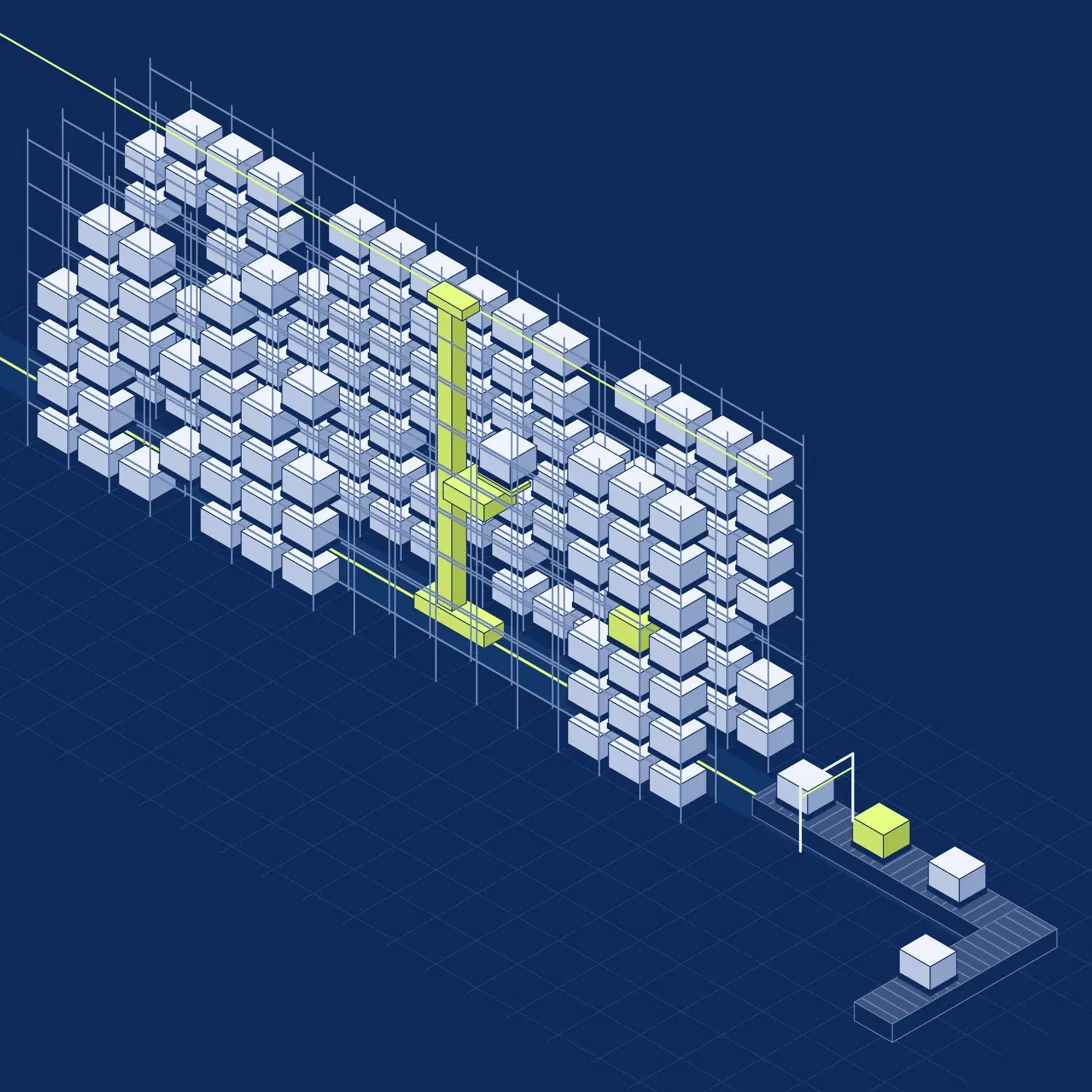
What is an automated high-bay warehouse?
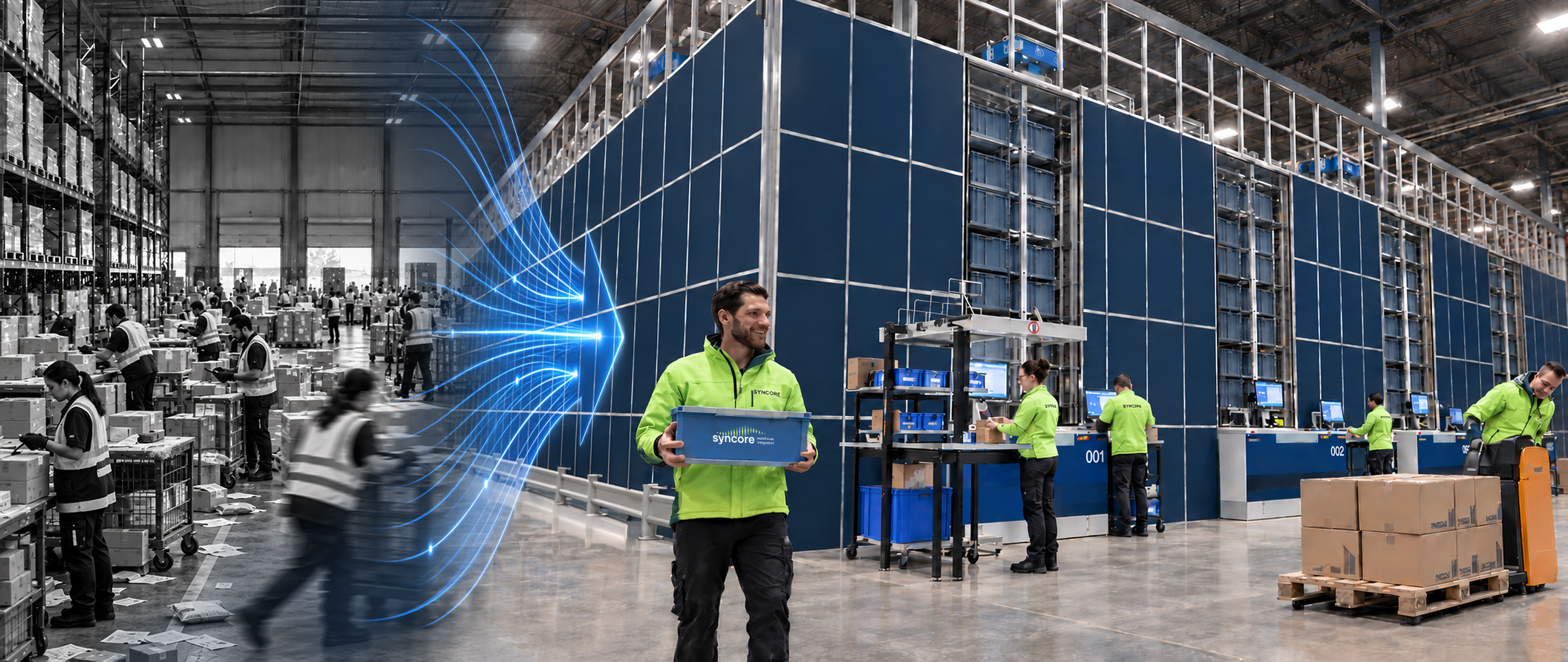
An automated high-bay warehouse (HRL) is a pallet warehouse with a great height, in which rack-handling devices or shuttles load and unload the load units without a driver. It is controlled by warehouse management software that tracks every storage location and every movement.
There is no standard height limit. In practice, a high-bay warehouse is typically defined as having a height of 12 m or more, though some sources set the threshold as low as 7.5 m. Today, systems with heights of 40 to 45 m are feasible.
Two distinctions help with classification:
• Manual high-bay racking: Narrow-aisle forklifts with operators are used to handle the racking. This method is more flexible, but slower, requires more staff, and has height limitations.
• Automated Small Parts Warehouse (AKL): It operates on the same principle but stores containers and boxes instead of pallets.
How an Automated High-Bay Warehouse Works
An automated high-bay warehouse consists of three components: the stacker crane in the rack, the conveyor system in the pre-zone, and the software that controls both. A pallet’s typical path looks like this:

At the identification point, the system checks whether the pallet meets the requirements for dimensions, weight, and condition. Goods that protrude or damaged pallets are diverted before they can cause disruptions on the shelf.
Rack-feeding machine and load-handling device
The stacker crane (RBG) travels along rails through the aisle, moving both horizontally (transverse axis) and vertically (vertical axis) at the same time. This allows it to reach every storage location by the most direct route. Single-mast stacker cranes are sufficient for light loads and lower heights, while heavy loads and great heights require double-mast stacker cranes. The load-handling device—that is, the component that grips the pallet and pushes it into the bay—is usually a telescopic fork for pallets. It extends sideways into the rack bay and picks up the pallet. The key to its efficiency is the double-cycle operation: the stacker crane stores one pallet on the outbound trip and picks up another on the return trip. This eliminates empty trips, and hourly throughput increases significantly compared to systems that operate on a single-cycle basis. Our overview of storage and retrieval machines for pallets and containers details the various designs and models.
Pre-zone and Conveyor Technology
The pre-zone is the area in front of the rack where pallets are delivered, inspected, distributed, and prepared for shipment. Roller and chain conveyors transport the pallets, transfer carts distribute them across multiple aisles, and lifts overcome differences in height. In addition, there are picking and shipping stations. In many projects, it is not the automated storage and retrieval system (ASRS) that limits throughput, but the pre-zone. If conveyor lines are undersized or buffers are missing, pallets back up in front of the rack. Therefore, plan the conveyor system for the pre-zone with the same care as the rack itself.
Inventory Management and Material Flow Control
The control system is organized in layers. The ERP system specifies what is needed. The warehouse management system (WMS) determines which pallet comes from which location. The material flow computer (WCS) translates this into specific movement commands and coordinates all equipment via the plant control system.

In the WMS, you define the warehouse strategies. Fast-moving items are placed in ABC zones near the front zone. With chaotic storage, each pallet is assigned the next available space. FIFO (first in, first out) or FEFO (first expired, first out) determine the order of picking. You can find more information about this in our warehouse management software
Design Types: Silo-style, Hall-style, or Built-in Storage
At high elevations and in open areas, silo construction is usually more cost-effective. For lower heights, in existing buildings, or where future repurposing is a possibility, there are more advantages to using a warehouse-style structure or an in-building storage system.

| Kriterium | Silobauweise | Hallenbauweise | Einbaulager |
|---|---|---|---|
| Bauhöhe | groß, typisch ab ca. 20 m | gering bis mittel | durch Bestandshalle begrenzt |
| Bauzeit | kurz, Regal und Gebäude in einem | länger, Gebäude und Regal nacheinander | kurz, kein Gebäudeneubau |
| Genehmigung | Neubau mit Brandschutzkonzept | Neubau mit Brandschutzkonzept | Nutzungsänderung, Brandschutz prüfen |
| Flexibilität | gering, Gebäude ist an das Regal gebunden | hoch, Halle anders nutzbar | hoch |
| Typischer Einsatz | großes, langfristig stabiles Palettenvolumen | mittlere Höhen, unsichere Zukunftsnutzung | Automatisierung bestehender Hallen |
Silo construction method
In the silo construction method, the rack itself supports the roof and facade. There is no need for a separate building; the racking and the structure are built as a single unit. This shortens construction time and pays off especially for structures of great height. Because the racking also serves as the building, it may be treated differently for tax purposes than a traditional warehouse. Be sure to clarify any questions regarding its classification as a business facility with your tax advisor early on.
Case Study: Euroma— Syncore built a 27-meter-high high-bay warehouse in a silo design for the spice manufacturer Euroma in Zwolle. The racking structure supports the building and provides approximately 18,000 pallet spaces. Six automatic pallet cranes and two miniload cranes, providing space for an additional 8,000 containers, operate in the facility. Approximately 500 m of conveyor systems connect the warehouse and production areas.
Hall Construction and Installation Bases
In the freestanding warehouse design, the racking system is located in a separate building. In the built-in warehouse design, it is integrated into an existing facility. Both options make sense if the building height remains moderate, if an existing building is to be utilized, or if the facility might be used for a different purpose in the future. For a built-in warehouse, the building height, column spacing, and floor slab determine what is possible. Have the floor’s load-bearing capacity checked early on.
Storage and Retrieval Machine, Pallet Shuttle, or a Combination?
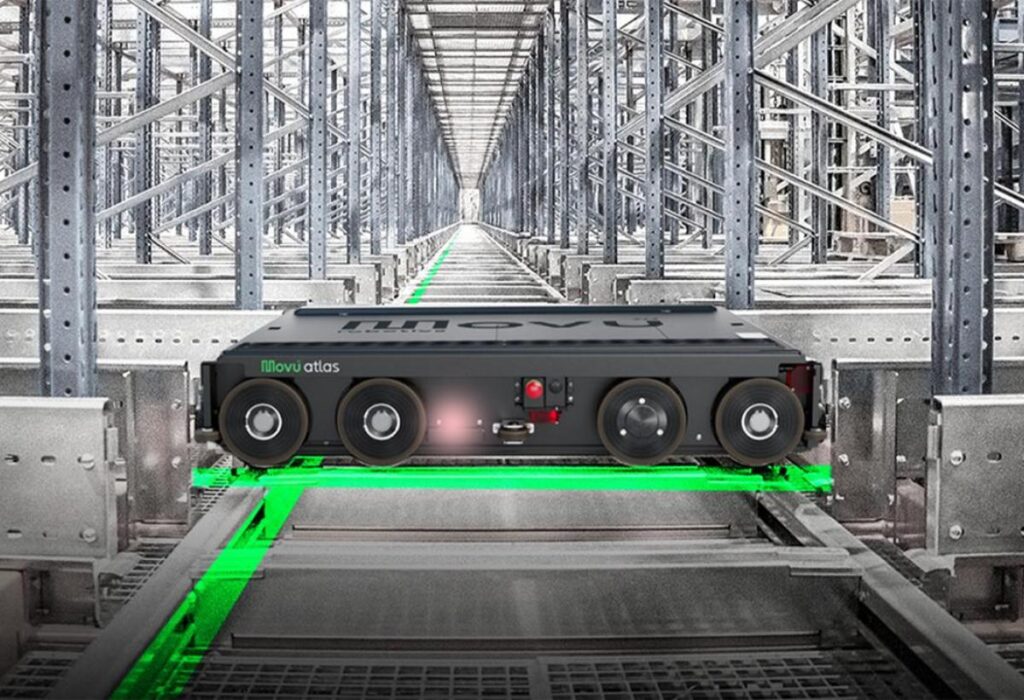
One rack-access vehicle per aisle offers high performance with a simple design. A pallet shuttle system provides high storage density and can be expanded incrementally with additional vehicles. The right solution depends primarily on the number of SKUs, the number of pallets per SKU, and the required throughput.
| Kriterium | Regalbediengerät | Paletten-Shuttle | Kombination |
|---|---|---|---|
| Lagerdichte | hoch, mit mehrfachtiefer Lagerung sehr hoch | sehr hoch durch tiefe Kanäle | sehr hoch |
| Durchsatz | hoch je Gasse | über Anzahl der Fahrzeuge skalierbar | hoch |
| Skalierbarkeit | über zusätzliche Gassen und Geräte | über zusätzliche Shuttles und Lifte | flexibel |
| Ausfallsicherheit | Gasse steht bei Ausfall des RBG | andere Fahrzeuge übernehmen | hoch |
| Investition | abhängig von Gassenzahl und Höhe | abhängig von Fahrzeug- und Liftanzahl | projektabhängig |
Single-depth, double-depth, and multi-depth storage
In single-deep storage, there is no pallet behind each pallet. Every pallet is directly accessible, which is suitable for many items that require only a few pallets. Double-deep and multi-deep storage places multiple pallets one behind the other, thereby increasing storage density.

The trade-off is access. If the pallet being sought is located at the back, the equipment must first reposition the load. Multi-depth storage is therefore particularly worthwhile for a small number of items with many pallets per item, such as in beverage or food production.
Straight, through curves, or with a gear change
An RBG traveling in a straight line serves exactly one aisle with racks on both sides. This configuration provides the highest throughput per aisle. A curved RBG moves through a curve into an adjacent aisle, thereby serving two aisles.

Aisle-crossing stackers operate across at least three aisles. They are suitable when high storage capacity is more important than speed. All models are available as single- or double-mast stackers and can be configured for single-, double-, or multiple-depth storage.
Pallet Shuttle as an Alternative
In the pallet shuttle system, vehicles travel along the rack levels or storage aisles, while lifts handle vertical movement. Because multiple shuttles operate in parallel, a malfunction does not result in a complete loss of capacity. As demand grows, you can add more vehicles instead of having to remodel the warehouse.
Containers and small parts in the same design concept
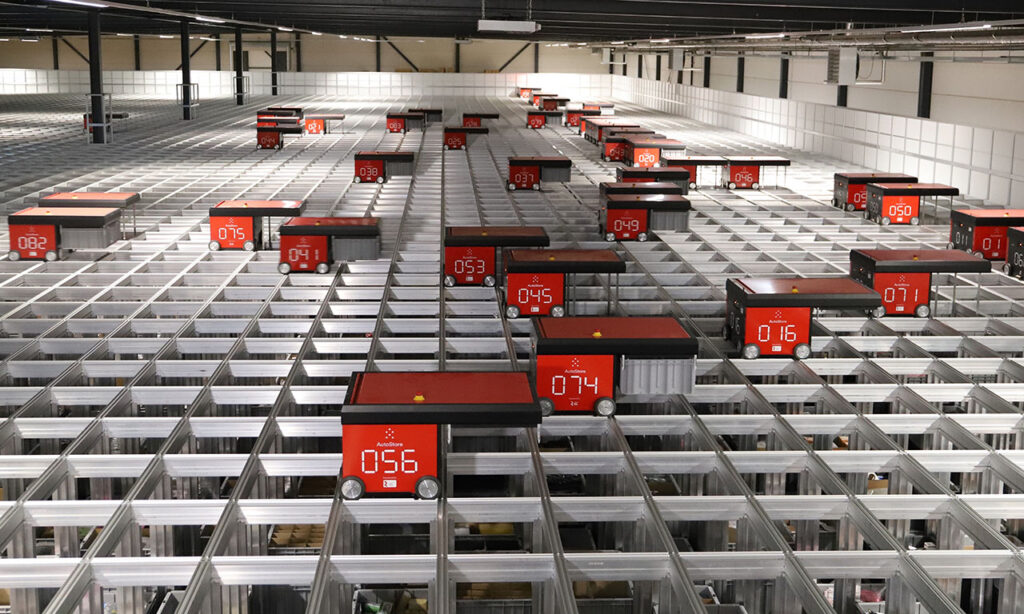
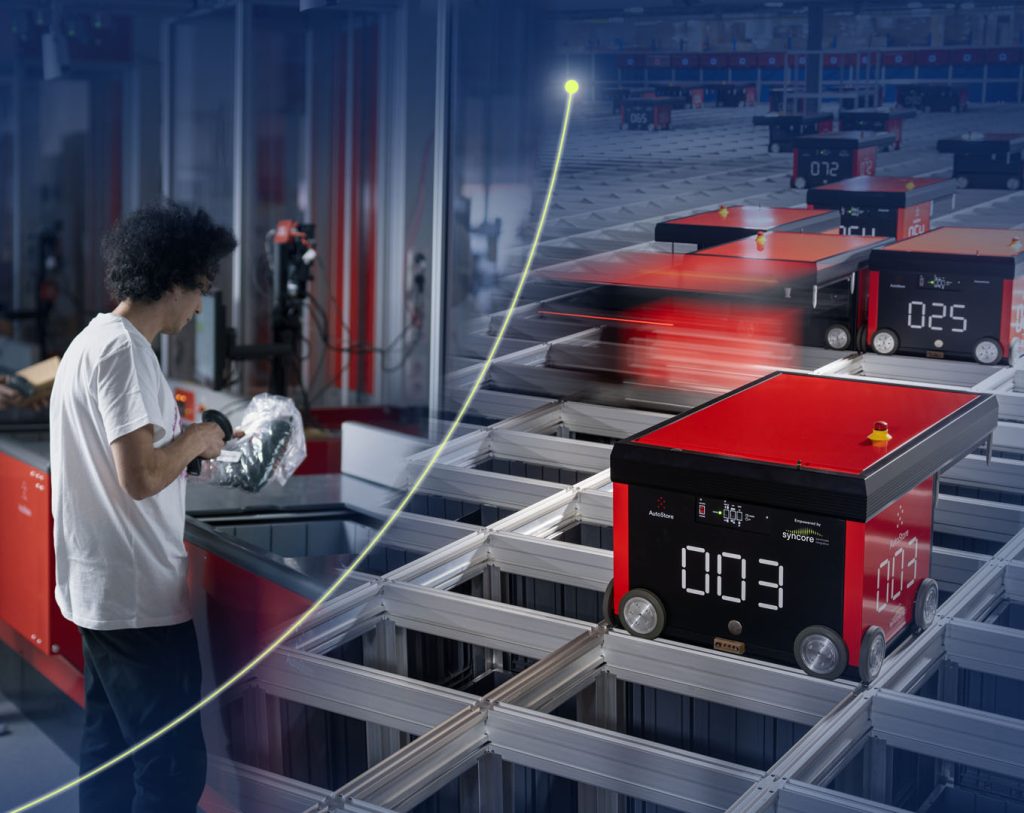
In addition to pallets, many companies also store containers and boxes. One option is to use miniload aisles in the same building, as is the case at Euroma. Alternatively, a separate “goods-to-person” system could be considered. For a very large number of small parts in a compact space, AutoStore for small parts is a proven complement to the pallet high-bay racking system.
Advantages and Limitations of an Automated High-Bay Warehouse
A fully automated high-bay warehouse saves space and reduces staffing needs, safeguards inventory, and operates around the clock. On the other hand, it requires a significant initial investment and offers less flexibility—though these drawbacks can be mitigated with proper planning.
| Vorteile | Grenzen und wie Sie sie abfedern |
|---|---|
| Flächen- und Raumausnutzung: Bauhöhe statt Grundfläche, schmale Gassen | Hohe Anfangsinvestition: Business Case über die gesamte Nutzungsdauer rechnen, nicht nur über die Baukosten |
| 24/7-Betrieb: keine Abhängigkeit von Schichtbesetzung | Geringe Flexibilität bei Ladungsträgern: Normpaletten festlegen und Sonderträger auf Trägerpaletten stellen |
| Bestandsgenauigkeit: jede Palette ist einem Platz zugeordnet | Starre Gebäudegeometrie: Erweiterungsflächen und Anschlusspunkte von Anfang an einplanen |
| Weniger Schäden: keine Anfahrschäden durch Stapler | Abhängigkeit von Steuerung und Service: Redundanz einplanen und Wartungsvertrag mit festen Reaktionszeiten abschließen |
| Planbare Personalkosten: Leistung skaliert ohne zusätzliche Fahrer | Planungsvorlauf: früh mit Datenanalyse und Genehmigung beginnen |
| Ergonomie und Sicherheit: kein Personal im Regalbereich |
For which industries and types of stored goods is an automated high-bay warehouse suitable?
An automated high-bay warehouse is ideal for any situation where a large number of similar load units need to be stored in a small space with high throughput. The industry is of secondary importance. These criteria make a high-bay warehouse the right choice:
• Many pallets with standardized dimensions
• High, consistent throughput
• Limited or expensive floor space
• Two- or three-shift operations
• Temperature requirements such as refrigeration or deep-freezing
It is less suitable for situations involving highly variable types of cargo, very bulky goods, or very low throughput.
Refrigerated and Frozen Storage Facilities
Automation really comes into its own in cold storage and deep-freeze warehouses. Employees no longer have to work in the cold, and every cubic meter of refrigerated space is utilized. Automated storage and retrieval systems can be designed for operating temperatures as low as −30 °C. You can find more information about automated cold storage facilities on our industry page.
Case Study: Pré Pain: At the bakery products manufacturer Pré Pain, pallet cranes move goods in and out of the cold storage facility.
Manufacturing, as well as food and beverages
In production, the HRL serves as a buffer between manufacturing and shipping or as a supply warehouse for raw materials. It delivers materials to the production line at precisely the right time and decouples production from shipping. In the food and beverage sector, batch tracking and FEFO are also implemented to ensure that older goods leave the warehouse first. You can find suitable concepts under “Warehouse Solutions for Production.”
How much does an automated high-bay warehouse cost?
There is no set price for an automated high-bay warehouse. The costs depend on the size, capacity, and specific conditions of your project. These factors drive the investment:
• Height and design: silo, warehouse, or integration into an existing structure
• Number of pallet spaces: depends on the size of the racking and the building
• Required throughput: determines the number of rack feeders or shuttles
• Conveyor system and pre-zone: length, branches, picking and shipping stations
• Software and interfaces: WMS, material flow computer, ERP integration
• Fire protection: Sprinkler system or oxygen reduction
• Temperature range: Refrigerated and frozen storage design of the building and equipment
• Service: Maintenance, spare parts, hotline, and remote maintenance
A comparison is only meaningful if you consider the cost per pallet space and the cost per pallet movement, not just the total amount.
When the Investment Pays Off
A comparison of the total cost of ownership over a 10- to 15-year period with that of a manual warehouse will show whether an automated high-bay warehouse is worthwhile. The most significant factors are the shift schedule and throughput. The more shifts and movements there are, the faster the system pays for itself.
A simplified calculation:
Annual savings = (number of employees per shift × number of shifts × labor costs) + space saved + avoided damage and inventory discrepancies − (energy + maintenance + service costs for the automated warehouse)
Payback period = Additional investment compared to manual warehousing ÷ Annual savings
Be sure to check the following points in particular:
1. How many pallets do you move per day, and what are the peak volumes?
2. How many shifts do you run today, and how many do you plan to run in the future?
3. What is the cost of additional space at your location—whether for rent, purchase, or new construction?
4. What is the current level of damage to goods, shelving, and forklifts?
5. How are workforce availability and labor costs trending in your region?
To learn how to put together this calculation in its entirety, read the article “Business Case for Warehouse Automation.”
Safety, Standards, and Fire Protection
For automated high-bay warehouses, the primary standards that apply are DIN EN 15620, DIN EN 15635, and DIN EN 528, as well as the Industrial Building Code in Germany. Each of these standards protects you, as the operator, in a different way:
• DIN EN 15620 specifies tolerances, deformations, and clearances for adjustable pallet racks. For you, this means that the rack and the automated storage and retrieval system (AS/RS) are guaranteed to fit together reliably.
• DIN EN 15635 governs the operation, maintenance, and inspection of storage facilities. It provides a clear framework for regular rack inspections.
• DIN EN 528 defines the safety requirements for stacker cranes. It protects personnel during maintenance and troubleshooting.
• The Industrial Building Code specifies fire compartments and fire safety requirements for industrial buildings. It directly influences building design and the permitting process.
When it comes to fire protection, sprinkler systems installed on the shelves or oxygen reduction are typically considered. With oxygen reduction, the oxygen content of the room air is lowered to a level where a fire cannot start. Coordinate the plan early with the building inspector, the fire department, and your property insurer. Changes made later are expensive and delay approval.
Modernize an Existing High-Bay Warehouse
An existing high-bay warehouse can be modernized without having to build a new one. With a retrofit, you can upgrade the control system, stacker crane drives, WMS, material flow computer, and ERP integration in stages while the facility remains in operation.
The advantage over building a new facility: the racking and building remain in place, and investment and risk are reduced. Critical areas are modernized first, while contingency plans ensure uninterrupted operations. Additionally, expansions can be integrated, such as new conveyor systems, robots, or increased storage capacity.
Case Study: Aspen Bad Oldesloe—At Aspen’s pharmaceutical facility, Syncore upgraded the control systems for the entire intralogistics operation without interrupting production. Production areas were connected, processes and equipment status were visualized centrally, and SAP WM was integrated. The result is higher availability and greater control reliability.
How long does it take to plan and build an automated high-bay warehouse?
That depends heavily on the design, the permitting process, and delivery times. Installing a warehouse within an existing facility is generally much faster than constructing a new silo-style building. In addition to the construction time, be sure to factor in data analysis, the design phase, and the ramp-up period.
How many pallets per hour can a stacker crane handle?
Performance depends on aisle length, headroom, travel and lifting speeds, storage depth, and the proportion of double cycles. The pre-zone also often limits actual performance. Compare quotes only if cycle times were calculated using the same method.
What happens if a stacker crane breaks down?
With one RBG per aisle, the pallets in that aisle are temporarily inaccessible. For this reason, the WMS distributes each item across multiple aisles. In addition, contingency plans, a spare parts inventory, and a maintenance contract with fixed response times ensure availability.
Can an automated high-bay warehouse also be used in a frozen-food environment?
Yes. Storage and retrieval machines can be designed to operate at temperatures as low as −30 °C. Automation is particularly beneficial in deep-freeze warehouses because it eliminates the need for staff to work in the cold and ensures that the expensive refrigerated space is fully utilized.
Can the high-bay warehouse be integrated with SAP or another ERP system?
Yes. The warehouse management system exchanges orders and inventory data with the ERP system via interfaces, such as SAP EWM or SAP WM. Alternatively, SAP EWM handles warehouse management itself, and the material flow computer controls the equipment.
What types of load carriers are available?
Euro pallets and industrial pallets are standard, and mesh boxes can also be stored. It is best to place special load carriers on uniform carrier pallets. It is important to determine the load carriers early on, because the shelving bays, conveyor systems, and load-handling equipment are designed with them in mind.
How much energy does an automated high-bay warehouse consume, and what are the benefits of energy recovery?
The drives for the rack-handling machines account for the largest share of energy consumption; in cold storage facilities, refrigeration is an additional factor. Through energy recovery, the drives generate electricity during braking and lowering, which is fed back into the grid. An automated warehouse also requires very little lighting and heating in the racking area.