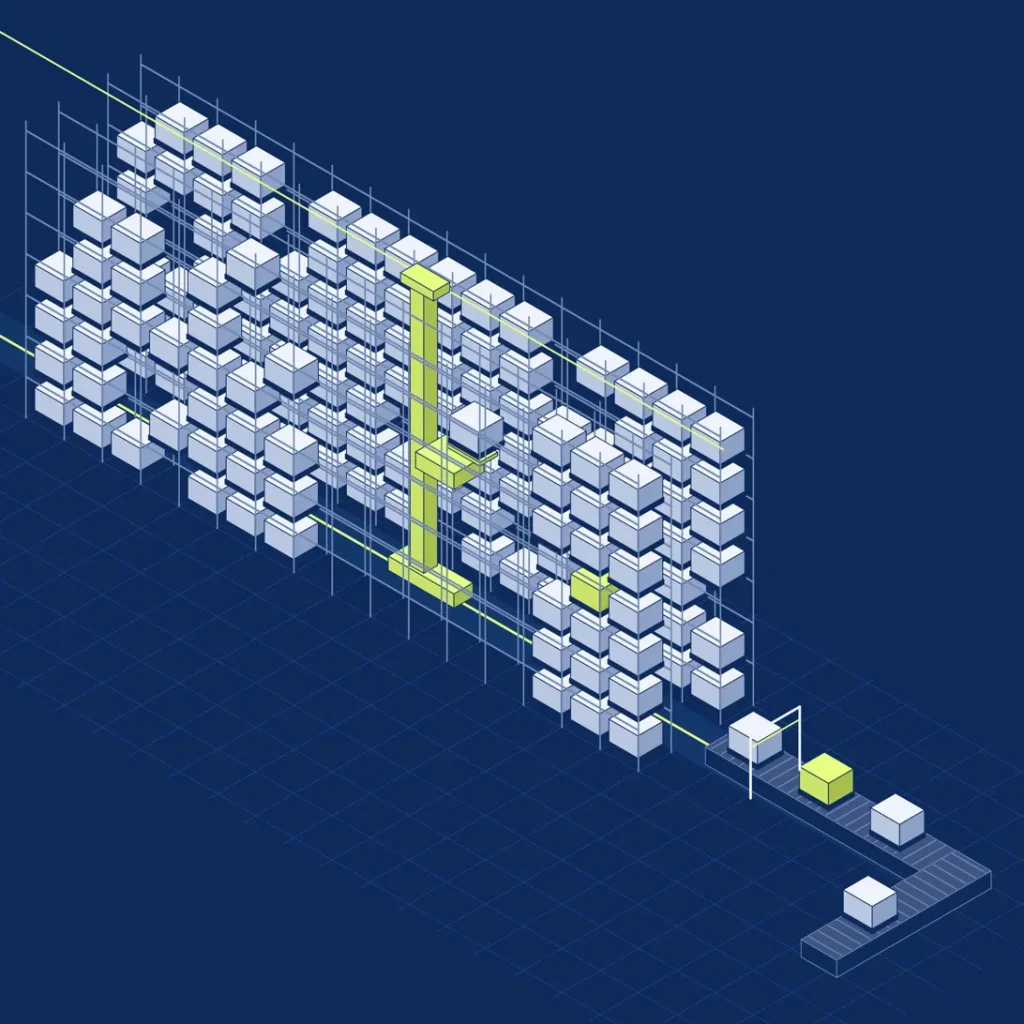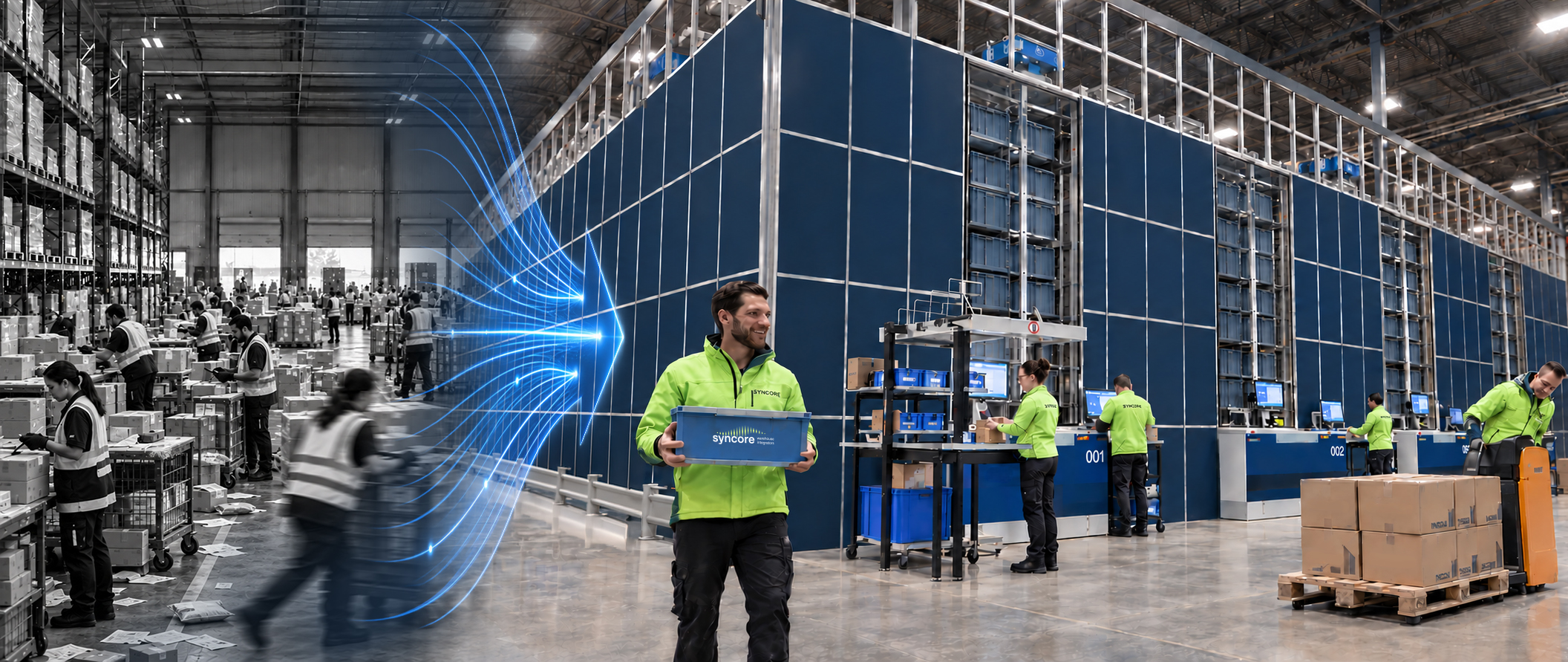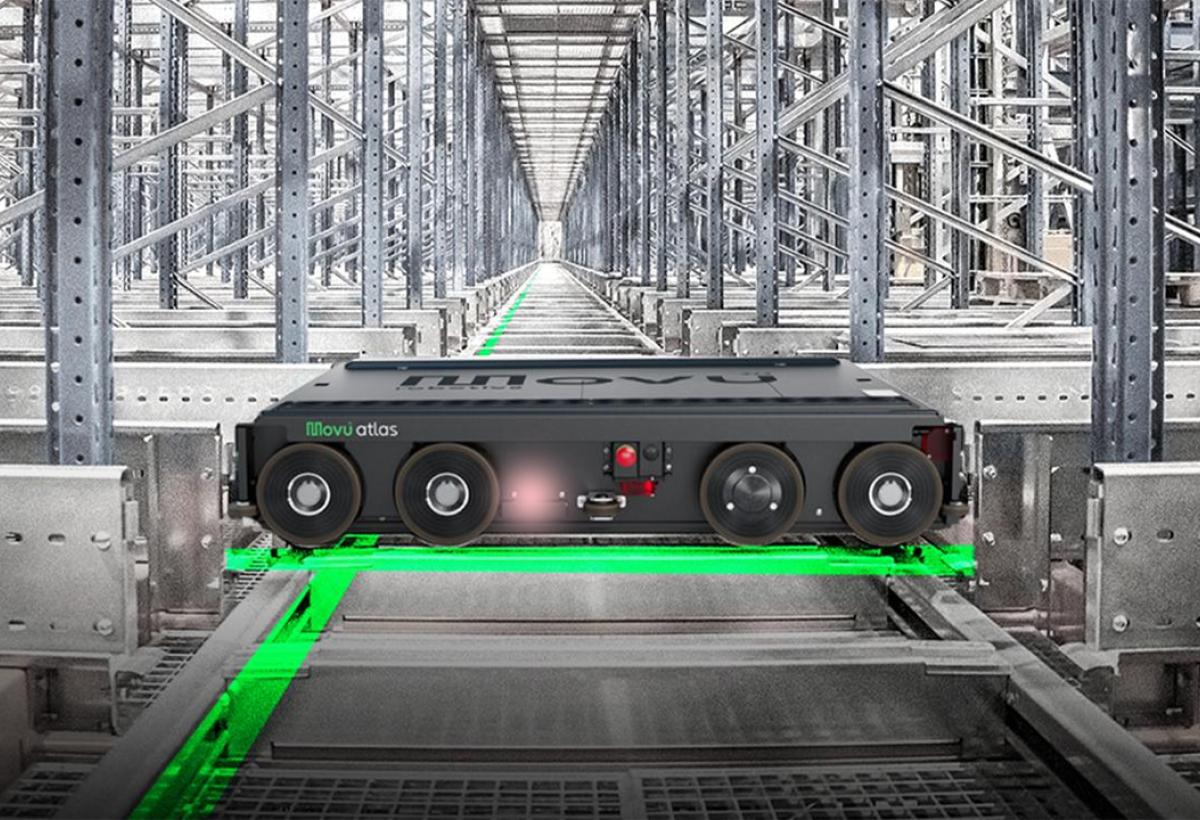
A pallet shuttle system is one of the technologies that meets these exact requirements. It automates the storage and retrieval of pallets within compact racking systems and makes significantly better use of existing storage space. At the same time, it reduces forklift traffic within the warehouse, making processes safer and more efficient.
Depending on the model, the system can be operated semi-automatically or fully automatically. The technology is suitable for, among others, manufacturing companies, logistics centers, and the food and beverage industry. Pallet shuttles are also frequently used in cold storage and deep-freeze warehouses, as they enable high storage density and can reduce energy consumption.
As a specialist in warehouse automation, Syncore supports companies in the planning and implementation of automated warehouse solutions. In addition to the AutoStore system for bin storage, Syncore also offers Movu Atlas, a high-performance solution for automated pallet storage. The goal is to tailor warehouse processes optimally to the specific needs of each company and make them more cost-effective in the long term.
What is a pallet shuttle system?
A pallet shuttle system is an automated storage system designed for the compact storage of pallets. Unlike in a traditional pallet rack system, the forklift does not drive all the way to the storage location but instead drops off the pallet at the entrance to a storage aisle. From there, an electrically powered shuttle takes over transport within the rack. The shuttle moves the pallet autonomously to the designated storage location and stores it there. If it is needed later, the shuttle retrieves it and returns it to the aisle entrance, where a forklift or conveyor system takes it over. There, it can then be picked up by a forklift or conveyor system.
This principle significantly reduces the travel distances of industrial trucks. At the same time, racking can be configured much more compactly, since wide aisles within the channels are no longer necessary. This results in significantly higher storage capacity within the same warehouse floor space. A pallet shuttle system is particularly cost-effective when handling large quantities of identical items or batches. For this reason, this warehousing technology is frequently used in the food, beverage, and chemical industries, as well as in production and distribution warehouses.
How does a pallet shuttle system work?
The process within a pallet shuttle system is straightforward and ensures a continuous flow of materials. First, a forklift or conveyor system transports the pallet to the entrance of a storage channel. The shuttle then takes over the pallet and moves autonomously to the designated storage location. There, the pallet is precisely positioned and stored. When a pallet needs to be retrieved, the shuttle travels to the corresponding storage location, picks up the pallet, and returns it to the channel entrance. From there, it is transported further by a forklift or an automated conveyor system. Depending on the system design, control is handled via a remote control, a warehouse management system, or fully automatically via a material flow control system. This allows all warehouse movements to be coordinated and documented.
What components make up a pallet shuttle system?
A pallet shuttle system consists of several components that are optimally coordinated with one another. The shuttle is at the heart of the system. It moves within the storage channels and handles all storage and retrieval processes. Modern shuttles are electrically powered and equipped with sensors that detect obstacles and enable precise positioning of the pallets. The racking system forms the foundation of the system. Special guide rails ensure that the shuttle can move safely within the channels. Thanks to its compact design, the available storage space can be utilized much more efficiently than with conventional pallet racks. The system is complemented by conveyor technology and warehouse management software. While the conveyor technology handles the flow of materials between goods receiving, production, and shipping, the warehouse management system manages all storage locations and controls transport orders.
Advantages of a Pallet Shuttle System
A pallet shuttle system offers companies numerous advantages over conventional pallet warehouses. This technology really shines, especially when large quantities of similar pallets are being stored or when the goal is to make optimal use of available warehouse space.
In addition to increased storage capacity, companies benefit from faster material flows, better utilization of storage space, and greater process reliability. At the same time, forklift traffic within the racking system is reduced, which improves both safety and efficiency in the warehouse.
More storage capacity in the same space
In many companies, available warehouse space is limited. New construction or warehouse expansions often require significant investment and cannot be completed on short notice. A pallet shuttle system utilizes the available space much more efficiently than conventional pallet racking. Since no forklift aisles are required within the racking system, significantly more pallet storage spaces can be created. Storage capacity can be increased considerably, especially when handling a large number of identical items or batches. The compact design pays off particularly in cold storage or deep-freeze warehouses. Every cubic meter saved reduces the volume that needs to be cooled and helps to permanently lower energy costs.
's Inventory Turnover Rises
Short delivery times and high product availability require efficient warehouse processes. Since the shuttle handles putaway and retrieval within the storage aisles, time-consuming forklift trips are eliminated. This allows pallets to be moved more quickly and makes it easier to coordinate incoming and outgoing goods. At the same time, waiting times in the warehouse are reduced, which increases overall throughput. Companies with high pallet turnover, in particular, benefit from these automated processes.
, Reduced Forklift Traffic
With conventional drive-in racking, forklifts often have to drive deep into the racking structure to store or retrieve pallets. This takes time and also increases the risk of damage to the racking and goods. A pallet shuttle handles this task entirely within the storage aisle. The forklift simply drops off the pallet at the entrance to the rack and picks it up again there later. This significantly reduces travel distances. At the same time, it eases the strain on drivers and vehicles.
Greater Safety in the Warehouse
Fewer forklift movements also mean greater safety. Since industrial trucks no longer need to travel through the rack aisles, the risk of collision damage to the racking system is significantly reduced. Collisions with goods or other vehicles can also be avoided. Modern pallet shuttles are also equipped with sensors that detect obstacles and monitor all movements. This ensures that storage and retrieval operations proceed reliably and in a controlled manner.
Scalable for future growth
Many companies are growing steadily. New products, higher order volumes, or additional warehouse capacity place high demands on intralogistics. Pallet shuttle systems can be expanded with relative ease. Depending on requirements, additional shuttles can be integrated or more storage channels can be added. This allows the system to grow with the company and reliably meet future needs.
Cost-Effectiveness
In addition to the logistical advantages, cost-effectiveness also plays a decisive role. Better use of space reduces the need for additional storage area. At the same time, operating costs are lowered thanks to shorter travel distances and more efficient processes. Maintenance and repair costs can also be reduced, as forklifts are used significantly less frequently within the racking system. For many companies, the investment therefore pays for itself within just a few years.
FIFO or LIFO—which inventory strategy is best?
A key advantage of a pallet shuttle system is that it allows for the implementation of different storage strategies. Which variant is used depends on the products being stored and the specific processes involved.
LIFO Principle (Last In, First Out)
Under the LIFO (Last In, First Out) principle, goods are placed into and removed from storage on the same side of the shelf. The pallet that was stored last is the first to be removed. This storage strategy is particularly suitable for products without an expiration date or for storage areas where identical goods are kept as buffer stock.
Typical applications include:
- Production Warehouse
- Raw Materials Warehouse
- Building Materials
- Buffer warehouse
- Chemical Products
FIFO Principle (First In, First Out)
Under the FIFO (First In, First Out) principle, pallets are stored on one side of the warehouse and retrieved from the opposite side.
This ensures that the goods stored first are also the first to leave the warehouse. This strategy is particularly important when products have a limited shelf life or are subject to legal documentation requirements.
FIFO is frequently used in:
- Food Industry
- Beverage Industry
- Pharmaceutical Industry
- Cosmetics Industry
- Cold Storage Logistics
A pallet shuttle system can be designed to support both storage strategies. Which option makes the most economic sense depends on the company’s product mix and logistical requirements.
For which companies is a pallet shuttle system suitable?
A pallet shuttle system is ideal for any location where large quantities of palletized goods are stored and high storage density is required.
This technology is particularly well-suited for companies that handle many pallets per item and have recurring material movements.
Food and Beverages
In the food and beverage industry, goods often need to be moved quickly while being stored under controlled conditions. A pallet shuttle system ensures high storage density and supports both FIFO processes and compliance with best-before dates.
Cold Storage Facilities and Freezer Warehouses
Refrigerated storage areas are among the most expensive storage spaces in a company. The more compact the storage, the smaller the volume that needs to be cooled. Pallet shuttle systems are therefore particularly well-suited for temperature-controlled and deep-freeze warehouses. At the same time, automation reduces the amount of time employees spend in cold work areas.
Production Company
In production, raw materials, semi-finished goods, and finished products must be available at all times. A pallet shuttle system ensures short transport distances and a reliable flow of materials between the warehouse and the production floor. This helps stabilize production processes and prevent bottlenecks.
Logistics and Distribution
Logistics service providers operate under intense time pressure and must move large volumes of goods every day. Automated warehouse processes allow pallets to be stored and retrieved more quickly. At the same time, this improves the utilization of existing warehouse space.
Chemicals and Consumer Goods
Companies in the chemical industry and manufacturers of fast-moving consumer goods also benefit from compact storage of large pallet inventories. The shuttle handles recurring transport tasks and ensures a continuous flow of materials.
Pallet shuttle system or traditional high-bay warehouse?
Companies looking to automate their pallet warehouses are often faced with the question of which technology is the right choice. In addition to pallet shuttle systems, traditional automated high-bay warehouses are also used. Both solutions aim to increase storage capacity and automate processes, but they differ significantly in their design and areas of application.
Which technology is more suitable depends, among other factors, on the number of items, throughput, available storage space, and future growth plans.
Storage capacity
A pallet shuttle system is particularly well-suited for companies that store large quantities of identical items. Since no aisles are required within the racking system, the available space can be utilized optimally. This results in significantly higher storage density than with conventional pallet racking.
Automated high-bay warehouses also offer high storage capacity, but are often designed for warehouses with a wider variety of items and more complex material flows.
Flexibility
Pallet shuttle systems can be expanded in stages. Additional shuttles or storage channels can be integrated as demand grows without having to adjust the entire warehouse design.
Changes to the product range can also be accommodated with relative ease. This makes this technology particularly well-suited for companies experiencing dynamic growth.
Capital Expenditures
Investment costs always depend on individual requirements. However, a pallet shuttle system often represents a cost-effective solution when the goal is to achieve high storage density while maintaining a moderate level of automation.
Fully automated high-bay warehouses, on the other hand, usually require more extensive structural modifications as well as additional conveyor systems and storage and retrieval machines. This increases both the investment costs and the planning effort.
Throughput
Both systems enable high throughput.
While automated high-bay warehouses really shine—especially with very complex material flows—pallet shuttle systems stand out thanks to short travel distances within the storage aisles and efficient handling of recurring warehouse operations.
The optimal solution therefore depends less on maximum capacity and more on the specific warehouse processes.
Extensibility
Another advantage of pallet shuttle systems is their modularity. Companies can integrate additional shuttles or storage areas as soon as their needs change or business volume increases.
This ensures that the warehouse remains adaptable over the long term, and investments can be made in phases.
Pallet Shuttle Systems in Cold Storage and Frozen Food Warehouses
Cold storage facilities are among the most demanding applications in warehouse logistics. Low temperatures, high energy costs, and strict hygiene requirements place special demands on warehouse technology.
This is precisely where pallet shuttle systems offer significant advantages.
Maximizing the use of the cooling surface
Every cubic meter that needs to be cooled incurs ongoing energy costs. The compact storage within the rack channels allows for significantly better use of available space than with traditional pallet racks. This reduces the required cooling volume and can lower operating costs in the long term.
Fewer trips to the cold storage facility
Since the shuttle transports the pallets within the storage aisles, forklift operators no longer need to drive into the racking system. This significantly reduces travel times while also improving safety. In addition, employees spend considerably less time in frozen areas, which improves working conditions.
High process reliability
Even at temperatures well below freezing, warehouse processes must function reliably. Modern pallet shuttle systems are specifically designed for use in refrigerated and frozen-food warehouses and ensure a reliable flow of materials even under demanding conditions. Companies in the food and beverage industry, in particular, benefit from this technology.
When is a pallet shuttle system a good investment?
Not every company needs the same level of automation. That is why every investment should be based on a thorough analysis of existing processes.
A pallet shuttle system is particularly suitable when:
- large quantities of identical pallets are stored
- to make optimal use of the available storage space
- The number of forklift trips should be reduced
- high throughput is required
- FIFO or LIFO processes must be implemented
- Refrigerated or frozen storage facilities are operated
- the company plans further growth
The sooner warehouse processes are analyzed, the easier it will be to accommodate future expansions.
What role does Movu Atlas play?
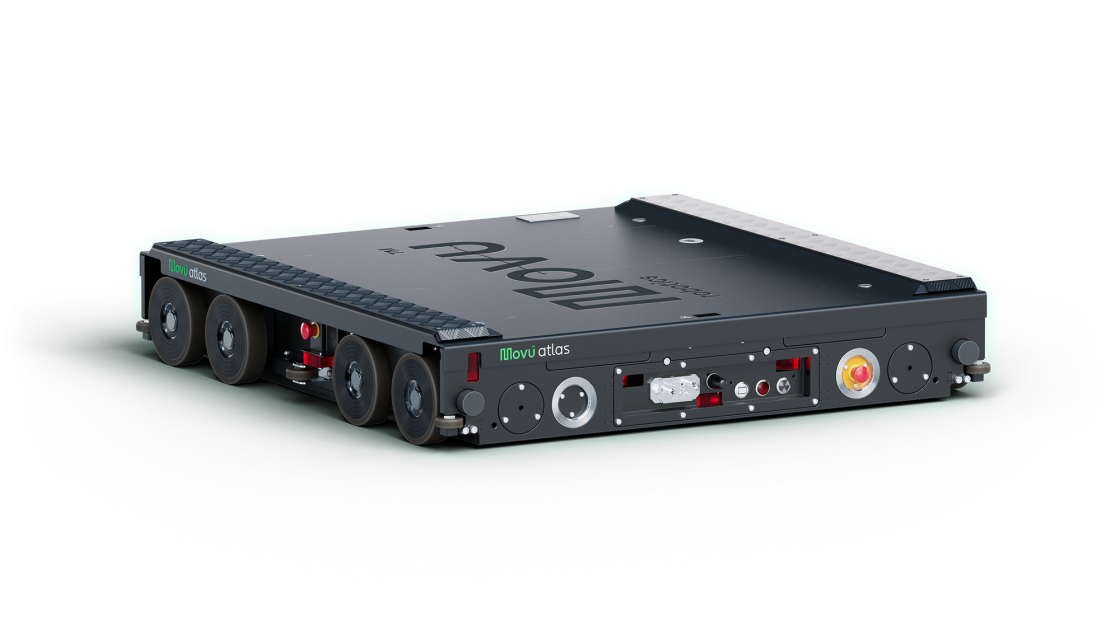
While many pallet shuttle systems are semi-automated, Movu Atlas enables fully automated pallet storage.
The system transports pallets autonomously within the storage channels and can be integrated with automated conveyor systems and warehouse management systems. This creates seamless material flows from goods receipt to shipping. A particular advantage is its high scalability. Companies can integrate additional shuttles and adapt the system’s capacity to meet increasing demands without having to fundamentally change the existing infrastructure. In addition, Movu Atlas is also suitable for demanding applications in cold storage and deep-freeze warehouses. For more information on this technology, please visit our page on the Movu Atlas Pallet Shuttle System.
Reasons for Using the Pallet Shuttle System
- Available for both longitudinal and transverse transport
- Load capacity up to 1,500 kg
- Scalability and Flexibility
Effectively Combining Pallet Shuttles and AutoStore
Not every warehouse consists exclusively of pallets. Many companies store not only pallets but also containers, cartons, or small parts.
In such cases, combining different automation technologies is a good solution. While a pallet shuttle system handles the storage of large goods on pallets, AutoStore is ideal for small parts that require frequent access. Both systems can be operated in parallel and integrated via a shared warehouse management system. This creates a seamless intralogistics solution in which each technology leverages its respective strengths. Companies benefit from optimal space utilization, short picking times, and high process reliability.
Planning a Pallet Shuttle System
The implementation of a pallet shuttle system begins long before the actual installation. To ensure that the new warehousing solution operates profitably over the long term, existing processes must be thoroughly analyzed. Factors such as product mix, turnover rate, storage capacity, and future growth play a key role in this process.
Analysis of Warehouse Processes
To begin with, existing material flows and warehousing processes are examined in detail. This involves addressing the following questions, among others:
- How many pallets are moved each day?
- How many different items are there?
- What inventory strategy is needed?
- Are there seasonal peaks in orders?
- What kind of automation makes sense in the long term?
Only once these questions have been answered can we determine whether a pallet shuttle system is the right solution or whether a combination of different technologies would be more appropriate.
Development of a Customized Storage Solution
Every company has different requirements for its intralogistics. That is why there is no standard solution that is equally suitable for all warehouses.
In the next step, a customized warehouse concept is developed based on the analysis. Among other things, the following aspects are taken into account:
- available warehouse space
- Hall Height
- Number of pallet storage spaces
- Material Flow
- Interfaces to ERP and WMS systems
- future expansion options
The goal is to develop a solution that both meets current requirements and accommodates future growth.
Assess Cost-Effectiveness
In addition to technical requirements, cost-effectiveness plays a crucial role. A pallet shuttle system can help to,
- to increase storage capacity,
- To reduce personnel costs,
- to speed up the flow of materials,
- to reduce forklift traffic,
- To reduce energy costs and
- to increase productivity on a long-term basis.
As part of a cost-benefit analysis, these potential benefits are weighed against the investment costs. This provides companies with a sound basis for decision-making.
Integration into Existing Processes
A modern pallet shuttle system does not operate in isolation but is integrated into the existing warehouse and IT infrastructure.
Depending on requirements, the following systems, among others, can be integrated:
- Warehouse Management System (WMS)
- ERP system
- Material Handling
- Automatic Goods Receipts
- Shipping Zones
- Production Supply
This creates a continuous flow of materials, which reduces the need for manual intervention and makes processes more transparent.
Why Syncore?
Implementing an automated warehouse solution is a long-term investment. This makes it all the more important to have a partner who not only supplies individual products but also supports the project throughout its entire lifecycle. For more than 50 years, Syncore has been developing automation solutions for companies in the industrial, retail, and logistics sectors. During this time, over 850 projects have been successfully implemented—ranging from individual automation components to complex intralogistics solutions. Syncore takes a holistic approach, focusing not on individual products but on the specific needs of each company.
Our range of services includes:
- Analysis of Existing Warehouse Processes
- Development of Customized Storage Solutions
- Planning Automated Warehouse Solutions
- Integration with existing IT systems
- Project Management
- Service and Support
What is a pallet shuttle system?
A pallet shuttle system is an automated storage system in which a shuttle independently transports pallets within a racking system. This allows for more efficient use of storage space and speeds up material flow.
How does a pallet shuttle work?
The pallet is placed at the entrance to a storage aisle. The shuttle then transports it to the designated storage location and automatically stores the pallet. For retrieval, the same process is followed in reverse order.
What is the difference between a pallet shuttle and a high-bay warehouse?
A pallet shuttle system is particularly well-suited for the compact storage of large quantities of identical items. Automatic high-bay warehouses, on the other hand, offer advantages when dealing with a wide variety of items and complex material flows.
When is a pallet shuttle system a good investment?
This technology is particularly well-suited for companies that handle a large number of pallets per item, have limited warehouse space, or have high requirements for storage density and throughput.
Which industries benefit from a pallet shuttle system?
Typical applications include the food and beverage industry, manufacturing companies, logistics service providers, and cold storage and deep-freeze facilities.
Can a pallet shuttle system be used in cold storage facilities?
Yes. Modern systems are designed for use in temperature-controlled storage areas and help make efficient use of cooling space and reduce energy costs.
What types of pallets can be stored?
Depending on the model, the system can accommodate Euro pallets, industrial pallets, CHEP pallets, and other common pallet sizes. The specific sizes supported depend on the system in question.
Is Movu Atlas a pallet shuttle system?
Yes. Movu Atlas is an automated pallet shuttle system designed for compact pallet storage and is suitable for use in production warehouses, distribution centers, and refrigerated and frozen storage facilities, among other applications.